AI Content Moderation on Adult Platforms
Contents
- What Is AI Content Moderation?
- Why AI Moderation Is Necessary at Scale
- How AI Content Moderation Works
- What AI Moderation Catches
- Limitations and Failure Modes
- The Role of Human Review
- Where AI Moderation Is Heading
AI content moderation on adult platforms is one of the less-discussed but more consequential applications of AI in this space — affecting what content stays up, what gets removed, and how quickly platform policies can be enforced at scale. This guide explains how it works and what its limitations are.
What Is AI Content Moderation?
AI content moderation refers to the use of machine learning models to automatically review, classify, and take action on content — typically images, video, or text — that may violate platform policies. On adult platforms, the most critical moderation targets include:
- Child sexual abuse material (CSAM) — the legal and ethical priority
- Non-consensual intimate imagery (NCII)
- Non-consensual deepfakes (see our deepfakes guide)
- Trafficking-related content
- Content that violates payment processor terms (which can be broader than legal requirements)
Why AI Moderation Is Necessary at Scale
The scale argument for AI moderation on major platforms is straightforward: large adult platforms receive enormous volumes of content uploads. OnlyFans, for example, has over 2 million creators and hundreds of millions of registered users — the volume of content on the platform is simply too large to manually review on any meaningful timeline.
Human review has two major constraints: cost and psychological harm. Reviewing content — particularly for CSAM and graphic violence — causes significant and documented psychological harm to human moderators. This is a recognized occupational health issue. AI moderation can process the same content at scale without this harm, with humans reviewing the AI's flagged cases rather than scanning the full volume.
How AI Content Moderation Works
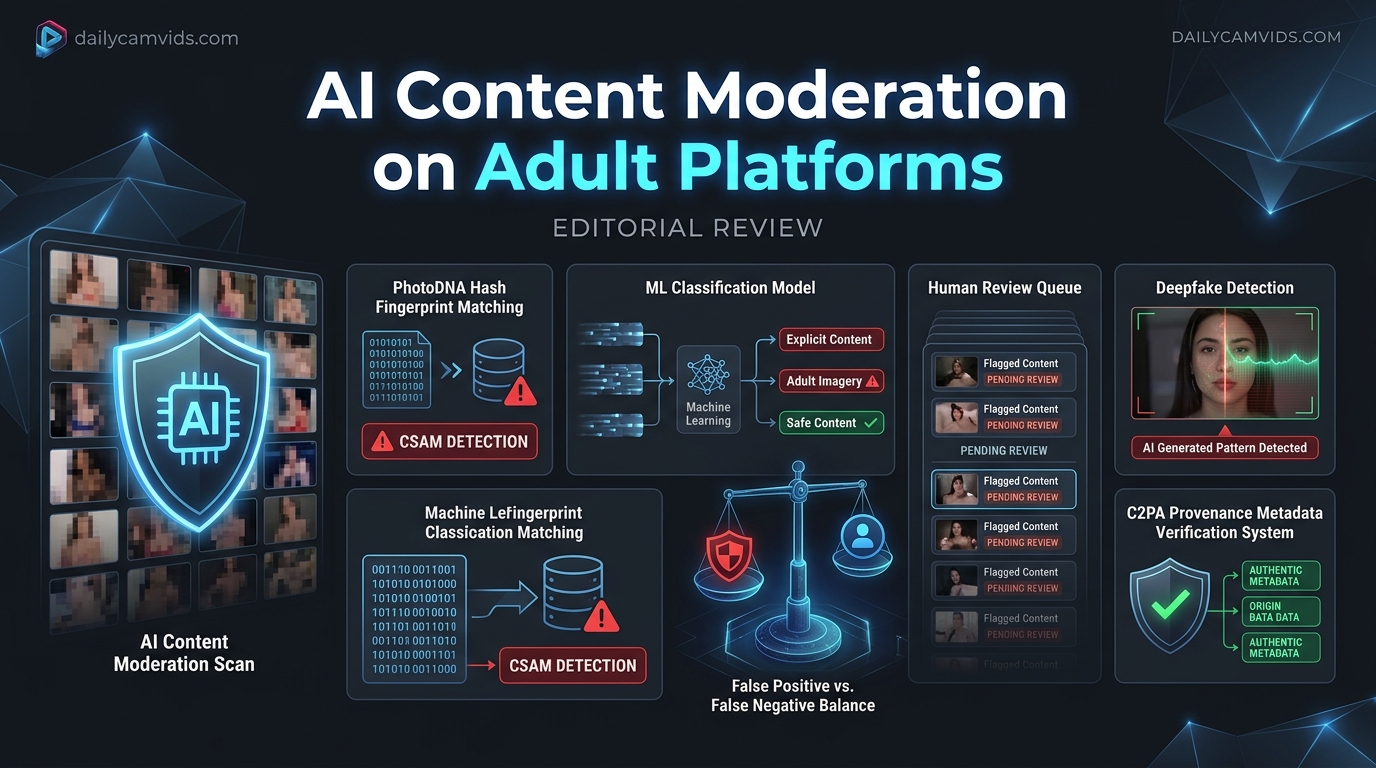
The most widely used approach to CSAM detection uses PhotoDNA, developed by Microsoft and now maintained by the National Center for Missing and Exploited Children (NCMEC). PhotoDNA creates a "hash" (a numerical fingerprint) of known CSAM images, and content uploaded to a platform is compared against this hash database. Matches trigger automatic removal and reporting to NCMEC, as required by US law. This technique is used by virtually all major platforms — adult and mainstream.
Beyond PhotoDNA, platforms use ML classification models trained to identify:
- Explicit content (for age-verification gating or general content warnings)
- Age-ambiguous content (triggering human review to verify performers are adults)
- Face recognition to identify potentially non-consensual use of specific individuals
- Text classification for identifying policy-violating messaging or solicitation
Classification models are trained on labeled datasets — content that human reviewers have already categorized — and learn to identify new content matching those categories. The quality of the training data and the ongoing calibration of these models significantly affects how well they perform.
What AI Moderation Catches
AI moderation is most reliable for:
- Known CSAM (via hash matching — very high accuracy for known material)
- Clearly explicit content classification (high accuracy for unambiguous adult material)
- High-volume pattern detection (repeated uploads of the same content, suspicious upload patterns)
Less reliable for:
- New (previously unseen) CSAM — hash matching only works for known material
- Sophisticated non-consensual deepfakes (as deepfake quality improves, detection accuracy decreases)
- Contextual policy violations (content that's fine in one context and violates policy in another)
- Novel categories of policy violation not well-represented in training data
Limitations and Failure Modes
AI moderation systems fail in two directions:
False positives (over-removal): Legitimate content flagged and removed incorrectly. This is a significant practical problem for creators, particularly when appeals processes are slow or opaque. Adult creators report disproportionate false positive rates on their content compared to mainstream creators on mixed platforms — the AI's calibration for what triggers review may be set conservatively in the adult content context.
False negatives (under-detection): Policy-violating content that AI systems miss. This is the more serious safety failure — CSAM or NCII that isn't detected and remains on the platform. No AI moderation system achieves zero false negatives at scale, which is why human review of samples and specific high-risk content remains important.
Both types of failure have real-world consequences — one for creators, one for the safety of platforms and victims.
The Role of Human Review
Effective content moderation systems use AI as a filter and prioritization tool, not as a fully autonomous decision-maker. Human review remains essential for:
- Appeals from creators who've had content removed incorrectly
- Reviewing AI-flagged content that falls in ambiguous categories rather than clear-cut violations
- Handling reports from users and performers about specific violations
- Auditing AI moderation system performance and recalibrating where false positive or negative rates are unacceptable
The quality and capacity of human review substantially affects how well the overall moderation system works in practice. Platforms that deploy AI moderation but inadequately staff human review end up with either over-removal (conservative AI + limited human override) or under-detection (liberal AI with limited human spot-checking).
Where AI Moderation Is Heading
Several developments are advancing AI moderation capability:
- Video deepfake detection: As deepfake generation quality improves, detection research is advancing in parallel — including techniques that analyze temporal consistency, audio-visual synchronization, and generation artifacts specific to current models
- Multimodal moderation: Models that can review text, image, audio, and video together, catching violations that only become apparent across multiple modalities
- Content provenance: C2PA metadata embedding by cameras and AI tools, if widely adopted, would allow platforms to verify content origin automatically
- Regulatory requirements: EU and US regulatory requirements for platforms to implement more rigorous detection and verification systems are likely to accelerate investment in moderation infrastructure
For the broader AI context in adult tech, see our analysis of how AI is changing the adult content industry.
React to this article
Comments
Loading…
Leave a comment
Loading…