Can You Tell AI-Generated Content from Real?
Contents
- Visual Tells in AI Images
- Signs in AI Video
- AI Detection Tools
- Content Provenance Systems
- Why Detection Matters
- Realistic Expectations
Can you tell whether an image or video was created by AI? The honest answer is: sometimes, with decreasing reliability as generation quality improves. This article explains what the current state of AI detection looks like — the tells that still exist, the detection tools available, and where the limits of human and automated detection lie.
Visual Tells in AI Images
Despite significant improvement in generation quality, AI images still exhibit characteristic artifacts that experienced observers can identify in some cases:
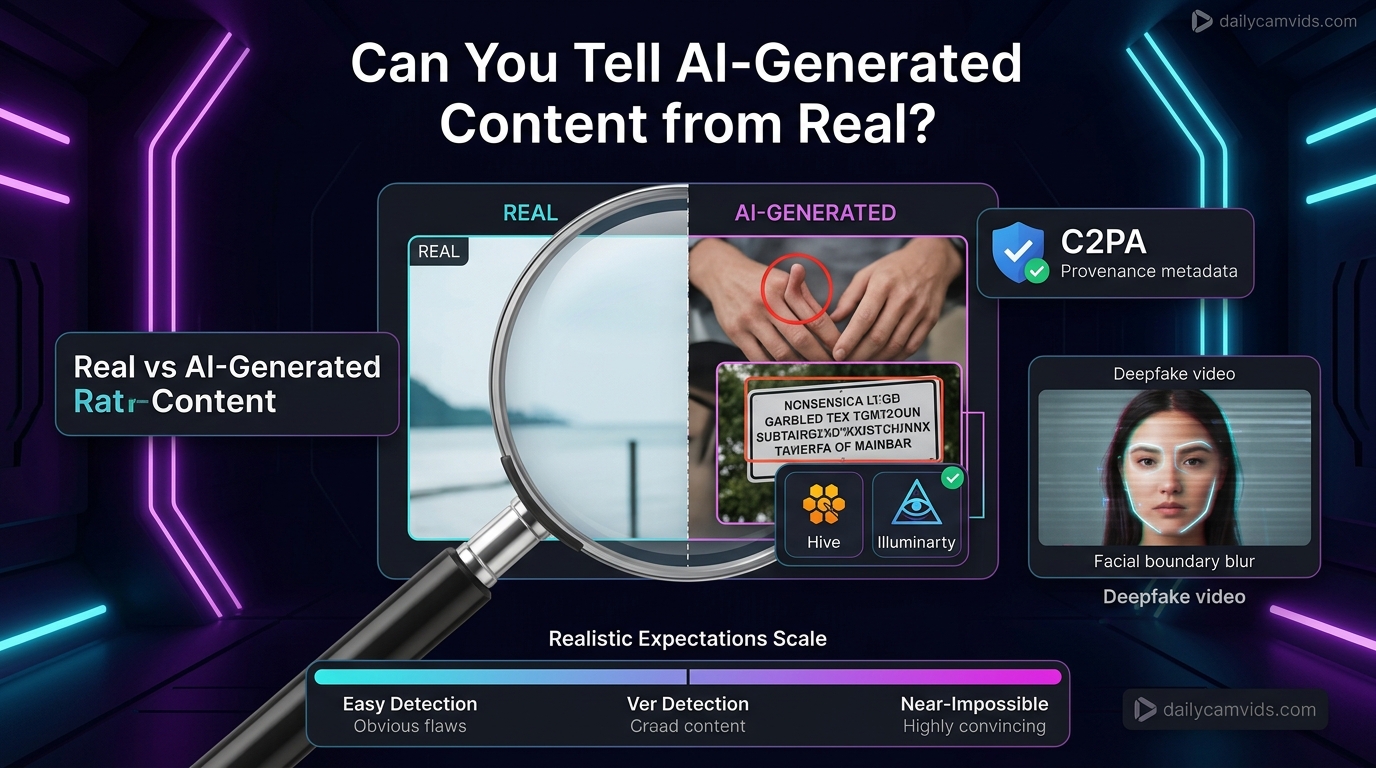
Hands and fingers: Historically the most reliable indicator — AI models have struggled with the complex geometry of hands, often producing extra fingers, merged digits, or anatomically inconsistent proportions. Newer models (Flux, DALL-E 3, Midjourney v6) have improved significantly here, but hands remain a useful check point.
Text within images: Text rendered inside AI images is often garbled, misspelled, or stylistically inconsistent. If an image contains visible text (signs, labels, written content), zooming in on that text often reveals AI generation artifacts.
Background inconsistencies: AI images often show "texture soup" in backgrounds — areas that look plausible at a glance but on closer inspection contain logical inconsistencies. Items that should have clear form become vague; architectural elements don't follow consistent geometry.
Ear and hair detail: Ears in AI images often show inconsistencies or anatomical implausibility. Hair, particularly at the edges, can show blending artifacts where it meets the background.
Lighting and shadow inconsistencies: AI images sometimes have lighting that doesn't come from a consistent source, or shadows that don't match the scene's implied light direction.
Overly smooth skin texture: AI portrait images often have an unnaturally smooth, airbrush-like skin texture — realistic photographs have visible pores, minor blemishes, and texture variation that AI generation tends to smooth out.
None of these tells are universally present in modern AI images. High-quality generation with prompt engineering can produce outputs that pass casual visual inspection. But the combination of multiple suspicious features in the same image remains a useful signal.
Signs in AI Video
AI video (including deepfake face-swaps) has additional detection dimensions compared to still images:
- Temporal consistency: AI video sometimes shows flickering or texture inconsistency between frames that doesn't occur in real video
- Facial boundary blur: In face-swap deepfakes, the edge between the swapped face and the original neck/hair/ears can show blending artifacts, particularly under movement
- Blinking patterns: Early deepfakes rarely produced realistic blinking; current models do better but blinking frequency and naturalness can still be slightly off
- Audio-visual sync: Lip movements not precisely matching speech, or voice characteristics not matching the face's apparent age and anatomy
- Background artifacts: Hair and background boundary artifacts similar to still images, but more visible through movement
AI Detection Tools
Automated AI image detection tools include:
- Hive Moderation: API service providing AI-generated image classification used by various platforms
- Illuminarty: Consumer-accessible tool for checking whether images are AI-generated
- AI or Not: Simpler consumer tool for quick checks
- DALL-E watermarking: OpenAI embeds watermarks in DALL-E outputs, detectable by their watermark detection service
Performance varies significantly by tool and by which AI generator produced the image. Detection tools calibrated on older generation methods perform poorly on newer models. Current tools achieve high accuracy on clearly AI-generated images and lower accuracy on high-quality, carefully post-processed AI outputs. Post-processing (compressing, screenshotting, cropping, color-grading) an AI image reduces detection accuracy substantially.
Content Provenance Systems
Content provenance — embedding verifiable metadata in images and video about their origin and editing history — represents a more systematic approach to the detection problem. The C2PA (Coalition for Content Provenance and Authenticity) standard, backed by Adobe, Microsoft, Sony, Nikon, and others, specifies how provenance data is embedded and verified.
Under C2PA, AI-generated images from participating tools carry embedded metadata indicating they were AI-generated. Major camera manufacturers are beginning to embed digital signatures in photographs taken with their cameras. This metadata can be verified by compatible tools to confirm the claimed origin.
The limitation: C2PA metadata is voluntary and can be stripped by saving an image through standard editing workflows. It's most useful as a positive trust signal (verified provenance indicates authentic origin) rather than as a universal detection mechanism (absence of provenance data doesn't confirm AI generation).
Why Detection Matters
In the adult content context specifically, detection matters for several reasons:
- Distinguishing human-performed content from AI-generated synthetic content — viewers may have a preference, and creators have a legitimate interest in the distinction being clear
- Identifying non-consensual deepfakes (see our deepfakes guide) that depict real people without consent
- Platform policy enforcement — most major platforms require disclosure of AI-generated content and some prohibit it entirely
- Legal compliance — several jurisdictions are enacting AI-generated content disclosure requirements
Realistic Expectations
The realistic state of AI detection in 2026: a motivated observer with good visual literacy can identify many AI images from tells — particularly older-model outputs and those that weren't carefully post-processed. Current automated detection tools perform well on unambiguous cases. State-of-the-art generation from the best current models, with careful prompting and post-processing, can produce outputs that are very difficult to detect reliably without provenance metadata.
This capability gap will likely persist and may widen as generation quality continues to improve. Content provenance systems, not retroactive detection, are probably the more sustainable long-term solution. For the ethical context, see the ethics of AI-generated adult content.
React to this article
Comments
Loading…
Leave a comment
Loading…