How the Cam Industry Has Changed Over the Last Decade
Contents
- Early 2010s: The Studio Era
- Mid-2010s: Platform Proliferation
- Social Media Integration
- Fan Sites and the Creator Economy
- Technology Shifts: Quality, Interactivity, and VR
- Regulation and Payment Policy Changes
- Where Things Stand in 2026
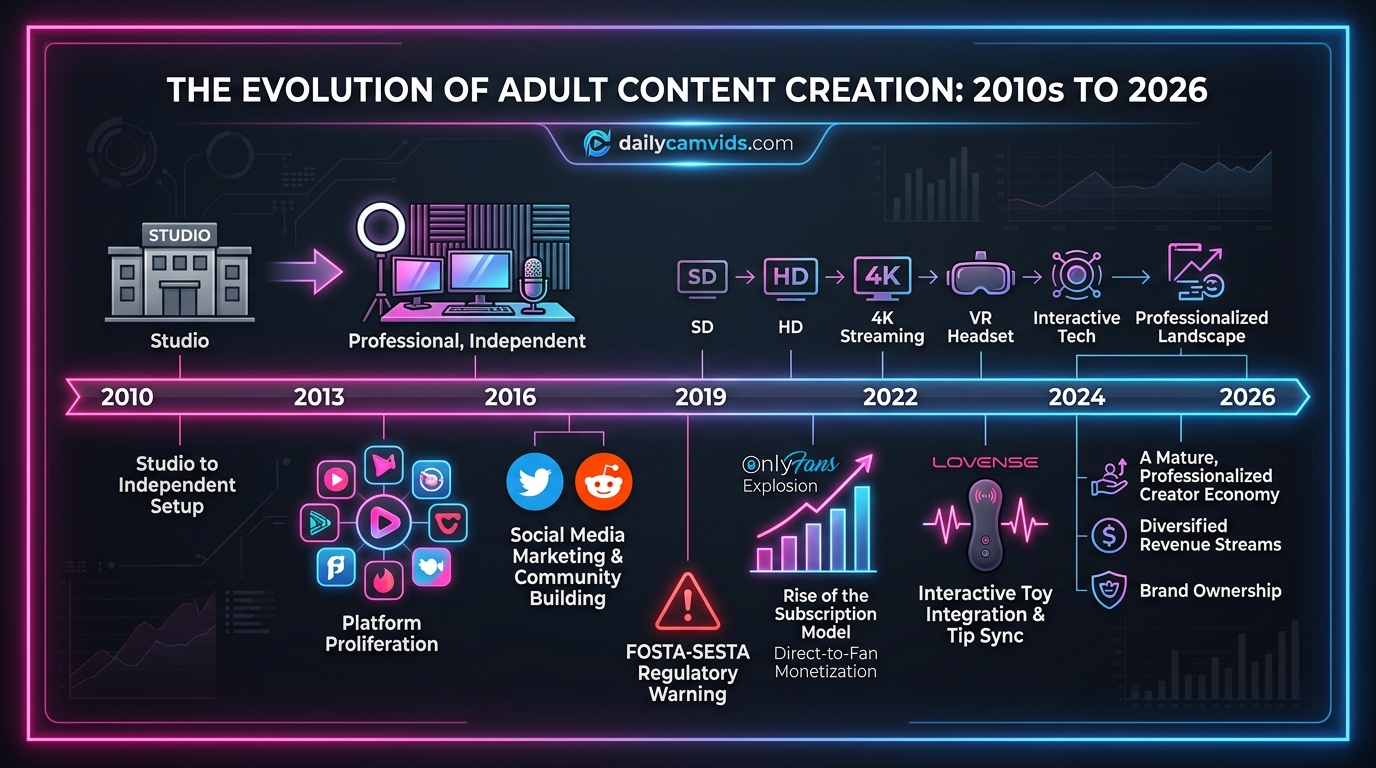
The live cam industry of 2026 is structurally different from what existed a decade ago. Changes in technology, payment infrastructure, platform competition, and creator economics have collectively transformed how the industry operates — for platforms, creators, and viewers alike. This historical overview traces those shifts to provide context for where the industry stands today.
Early 2010s: The Studio Era
In the early part of the last decade, live cam broadcasting was predominantly organized through studio operations — particularly in countries like Romania, Colombia, and Hungary that became significant production centers. Studios provided the physical infrastructure (space, equipment, internet connections), marketing, and platform accounts, in exchange for taking a significant portion of the revenue models typically between 40-70% of earnings.
The studio model made cam broadcasting accessible to people without the capital to set up their own operations, but it also created significant dependency and limited individual creator control over scheduling, platform presence, and financial outcomes. Platform terms, audience relationships, and all business decisions flowed through studio operators rather than through individual performers.
The major platforms of this era — Chaturbate, LiveJasmin, MyFreeCams, ImLive — established the core interaction models that still exist today: token tips, private shows, public broadcasts with goal systems.
Mid-2010s: Platform Proliferation
The mid-2010s saw significant growth in the number of competing cam platforms, each with variations on the established model. This competition benefited creators through better revenue splits and more choices — platforms competed on payout rates and features to attract top performers who drove disproportionate traffic.
Technology access expanded rapidly during this period. Declining costs of webcams, lighting equipment, and broadband internet gradually made independent home broadcasting viable without studio infrastructure. The shift from studio to home-based broadcasting was underway before the late 2010s, but accelerated significantly thereafter.
Clip sites like clips4sale and Manyvids grew as complementary income sources, allowing performers to sell recorded content as a passive income stream alongside live broadcasting. This established the multi-platform income strategy that has since become standard practice.
Social Media Integration
Twitter (now X) became a critical discovery and promotional tool for adult creators in the mid-to-late 2010s. Unlike most mainstream social platforms, Twitter maintained a relatively permissive policy toward adult content (with age-gating), giving cam models a mainstream social media presence to promote broadcast schedules, connect with fans, and build audiences outside the cam platform ecosystem.
Instagram and TikTok, with stricter content policies, forced more creative approaches — "safe for work" personas, careful content selection, and driving followers from restricted platforms to less-restricted ones. Social media strategy became a distinct professional skill set within cam modeling, separate from broadcasting performance itself.
This period also saw the rise of Reddit communities where creators could promote content and engage with potential viewers — another off-platform audience development channel that became part of standard practice.
Fan Sites and the Creator Economy
The launch and rapid growth of OnlyFans (founded 2016, explosive growth from 2018-2020) was arguably the most significant structural shift in adult creator economics in the decade. OnlyFans offered an 80% revenue split — dramatically better than most cam platform arrangements — and a subscription model that created recurring, predictable income alongside tip and PPV revenue.
The mainstream media coverage of OnlyFans earnings during the COVID-19 pandemic (2020-2021) drove the largest influx of new creator sign-ups the industry had seen, simultaneously expanding the creator supply and normalizing adult content creation in mainstream culture to a degree that hadn't existed previously.
Competing fan site platforms (Fansly, ManyVids subscriptions, and others) emerged to compete with OnlyFans, particularly after OnlyFans' announced (and then reversed) policy change in 2021 that caused significant creator uncertainty. Platform diversification became a risk management strategy, not just an income maximization strategy.
For more on how independent fan site economics work, see our article on the rise of independent adult creators and the economics of subscription platforms.
Technology Shifts: Quality, Interactivity, and VR
Broadcast quality has improved dramatically. HD (720p) was considered a differentiator in the early 2010s; full HD (1080p) is now standard, and 4K broadcasting is technically available on leading platforms, though viewer uptake has been limited by bandwidth requirements on the viewer side.
Interactive technology — particularly Lovense and similar devices that sync physical responses to tip amounts — transformed the tip incentive model. These integrations created new participation mechanics that significantly increased tip volume on broadcasts that used them, and the technology has become a standard feature of many performers' setups.
Virtual reality (VR) content emerged as a niche premium category. Several platforms developed VR-compatible broadcast capabilities, and while VR adoption hasn't reached the mainstream penetration that was predicted by industry optimists circa 2017-2018, it represents a stable premium tier for viewers with headsets.
Regulation and Payment Policy Changes
FOSTA-SESTA legislation in the US (2018) and the broader regulatory environment it signaled had ripple effects across the adult industry, including cam sites. Payment processor restrictions intensified in the years following, with several major processors introducing or tightening restrictions on adult content transactions. This forced platforms and creators to navigate limited payment processing options and affected payout timing and available methods.
Age and identity verification requirements increased across most major platforms during this period, driven by both regulatory pressure and payment processor requirements. This added friction to creator sign-ups but became standard practice. For more on how platforms handle payments, see how adult platforms handle payments and payouts.
Where Things Stand in 2026
The industry in 2026 is characterized by a more professionalized, independent creator model than existed a decade ago. The studio system hasn't disappeared — particularly in regions with lower independent infrastructure access — but home-based, independently operated creators now represent a larger share of total output and revenue than at any prior point.
Platform consolidation continues alongside new entrant competition. AI tools are increasingly integrated into content discovery, recommendation systems, and creator-audience matching. The category also faces continued regulatory attention in multiple jurisdictions. For a forward-looking view, see our analysis of adult content trends to watch in 2026.
React to this article
Comments
Loading…
Leave a comment
Loading…