How to Talk to a Partner About Boundaries
Contents
- Why These Conversations Are Difficult
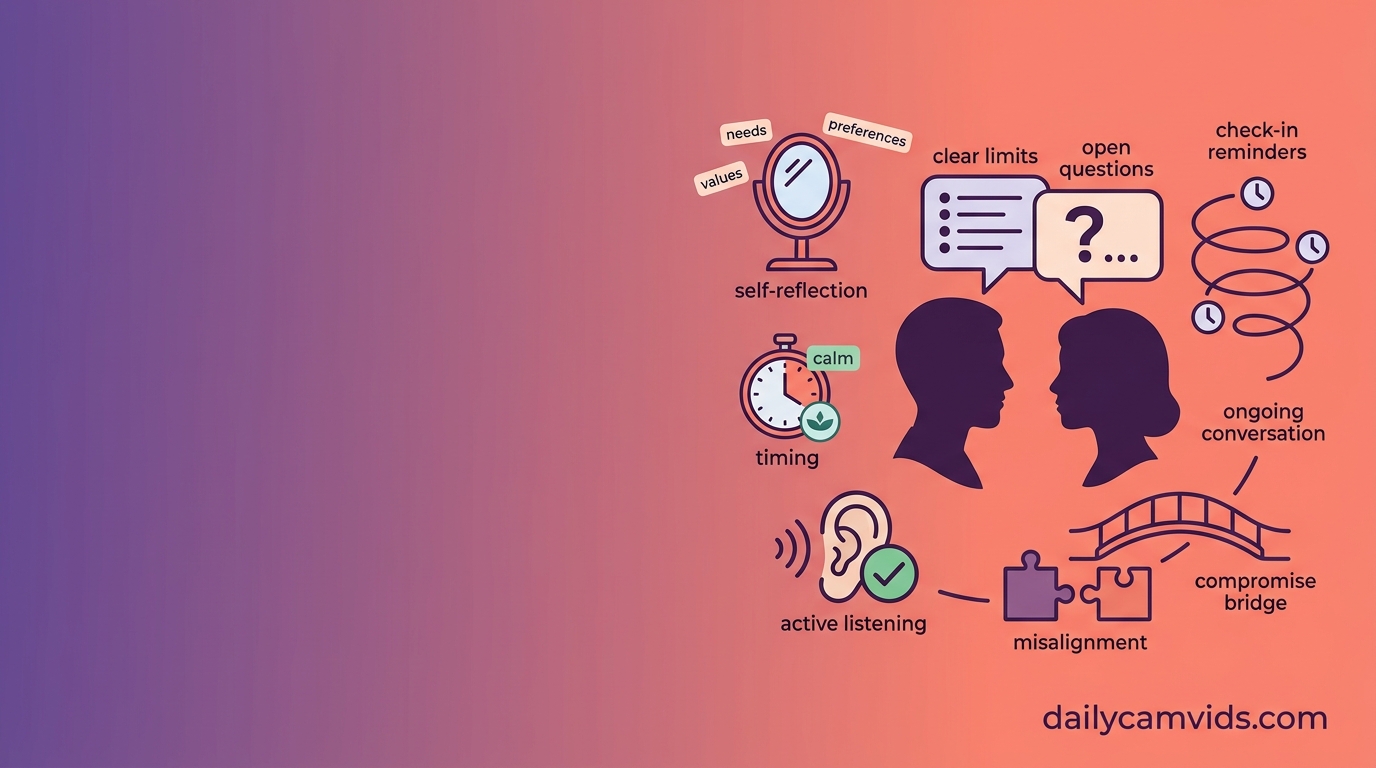
- Before the Conversation: Clarity for Yourself
- How to Start
- Expressing Limits Clearly
- Listening to a Partner's Boundaries
- When Limits Are Misaligned
- Boundaries as an Ongoing Conversation
Talking to a partner about sexual boundaries and preferences is a fundamental communication skill in relationships — and one that many people find genuinely difficult. This guide focuses on practical approaches: how to prepare, how to start, and how to handle the full range of responses.
For general educational purposes. A therapist or counselor can provide support for complex relational situations.
Why These Conversations Are Difficult
Several factors make conversations about sexual limits challenging for most people:
- Vulnerability: Expressing what you do and don't want sexually requires being honest about your inner experience — which feels risky, particularly with someone whose opinion matters to you.
- Fear of rejection or judgment: Concern that your partner will respond negatively to your preferences, kinks, or limits.
- Cultural messaging: Many people grew up in environments where talking openly about sex was shameful, inappropriate, or avoided entirely. Those norms are internalized and don't disappear because you're now in an adult relationship.
- Not knowing what you want: Before you can communicate your limits, you need to have identified them — which requires self-reflection that not everyone has been prompted to do.
Understanding why the conversation is difficult is the first step to approaching it more intentionally.
Before the Conversation: Clarity for Yourself
Before discussing limits with a partner, getting clear on your own is useful preparation:
- What do you actively enjoy and want more of?
- What are you neutral about?
- What do you prefer not to do but can accommodate?
- What are firm limits for you?
This doesn't require perfect clarity — you can acknowledge uncertainty ("I'm not sure how I feel about X") — but having some sense of the categories helps structure the conversation.
How to Start
Timing and framing matter significantly for how well these conversations go:
Timing: Not in the middle of a sexual encounter, and ideally not immediately before or after one. Neutral, relaxed moments — during a walk, over a meal, when you're both calm and not preoccupied — tend to produce better conversations than high-emotion or high-pressure moments.
Frame it positively where possible: Starting from "I'd love to try X" or "I really enjoy it when we do Y" is easier to receive than leading with prohibitions. Once a positive, communicative tone is established, discussing limits feels less like issuing rules.
Signal that you want a two-way conversation: "I wanted to talk about what we both like and don't like" invites your partner into the conversation rather than framing it as a list of your requirements.
Some couples find it helpful to approach this as a structured exercise — independently listing things they'd like to try, things they'd be open to, and things that are off the table, then comparing notes. This de-personalizes the conversation somewhat and makes simultaneous disclosure easier.
Expressing Limits Clearly
Clarity is more important than softness when expressing firm limits. "I'd really prefer not to do X" is more actionable than "I'm not sure about X." If something is a genuine limit for you, expressing it clearly — even if it requires directness — is more respectful to both of you than vagueness that leaves your partner guessing.
It's also worth distinguishing between firm limits ("I won't do X") and preferences ("I don't love X, but I can if it matters to you") — these are different categories and communicating the distinction helps a partner understand what has flexibility and what doesn't.
You don't owe a partner a detailed explanation for your limits. "I don't want to do that" is complete. Providing context can help a partner understand, but you're not required to defend or justify your limits.
Listening to a Partner's Boundaries
Receiving a partner's limits requires a different set of skills. Key practices:
- Listen without immediately becoming defensive or reassuring — let them finish what they're expressing
- Accept limits without argument, negotiation, or repeated asking — a "no" on a specific thing is final unless the person independently revisits it
- Thank your partner for communicating clearly — positive responses to honest communication encourage more of it
- Be honest about your own responses — if a partner's limit affects you significantly, expressing that honestly (not as pressure but as honest communication) is appropriate
When Limits Are Misaligned
Sometimes partners discover that their limits or preferences are significantly misaligned — one person strongly wants something the other firmly does not. How this is navigated depends on the specifics:
- Most preferences have room for compromise, creative alternatives, or finding what works for both
- Firm limits on either side should be respected — pressure to override someone's limits is not acceptable regardless of how significant the preference is on the other side
- Some misalignments reflect deeper incompatibility that may be worth discussing more broadly in the relationship context
A couples therapist or sex therapist can be genuinely helpful when communication around these issues feels stuck or when misalignments are causing significant friction. See our guide on when to see a professional for guidance on that.
Boundaries as an Ongoing Conversation
Limits and preferences change over time. What someone was comfortable with earlier in a relationship may no longer apply. New things a person wants to explore emerge. Circumstances in life affect desire and comfort. Treating the conversation about limits as a one-time event misses the evolving nature of both relationships and individual sexuality.
Couples who normalize ongoing, low-stakes check-ins about what's working for them — without those check-ins requiring a formal "relationship conversation" — tend to navigate these changes with less friction. The goal is making this kind of communication ordinary rather than charged. See our communication tips guide for broader relationship communication practices.
React to this article
Comments
Loading…
Leave a comment
Loading…