Sexual Health Basics Everyone Should Know
Contents
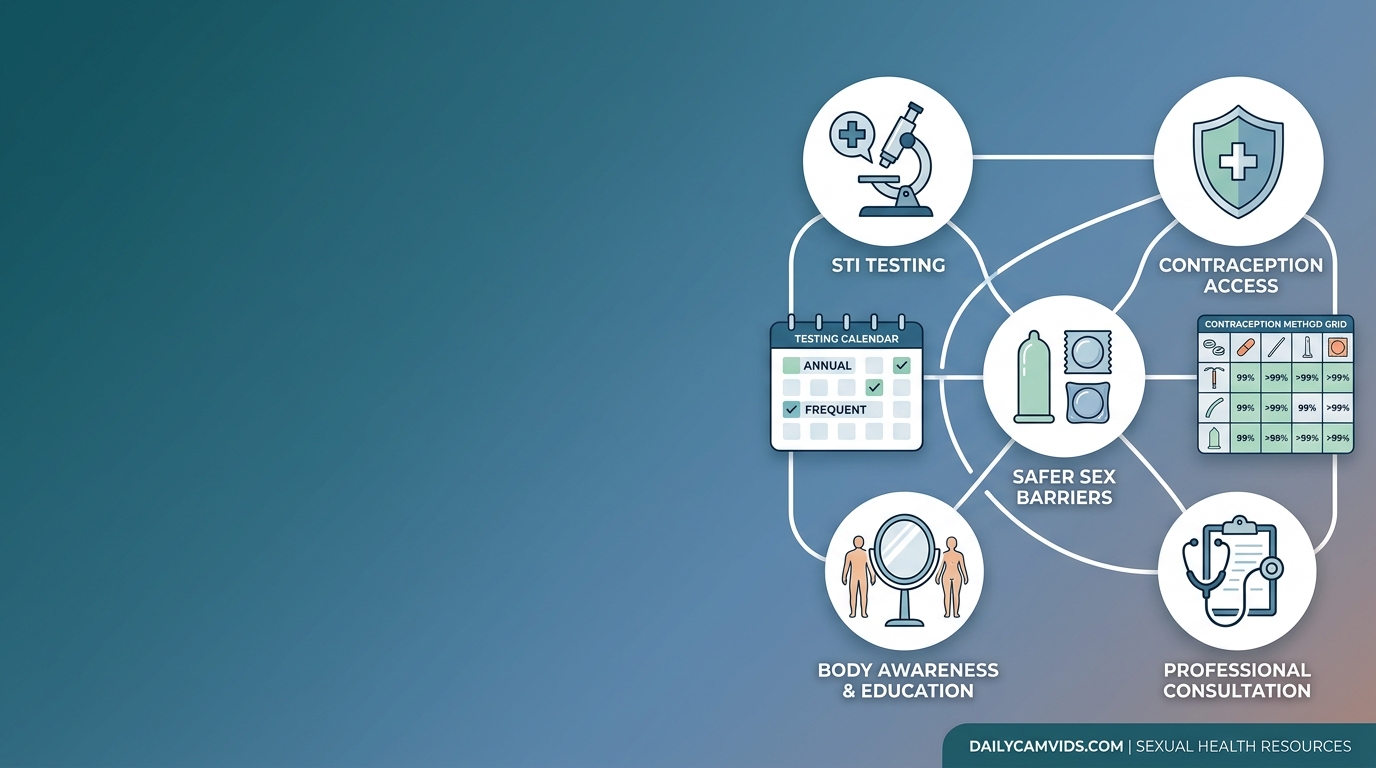
- STI Basics
- Testing and Screening
- Contraception Overview
- Safer Sex Practices
- Knowing Your Anatomy
- When to Seek Healthcare
This guide covers the sexual health basics that form a foundation for making informed decisions — information that everyone who is sexually active, or who is considering becoming sexually active, should have access to. The goal is clarity without jargon, and practical relevance without being prescriptive about your specific choices.
This is general educational information, not personalized medical advice. Consult a healthcare provider for personal health questions.
STI Basics
Sexually transmitted infections (STIs) — sometimes called STDs (sexually transmitted diseases) — are infections passed primarily through sexual contact. The most common include chlamydia, gonorrhea, syphilis, herpes (HSV-1 and HSV-2), HPV, HIV, hepatitis B, and trichomoniasis.
Key facts:
- Many STIs have no symptoms, or symptoms that could be confused with something else. You can't know your status without testing.
- Most bacterial STIs (chlamydia, gonorrhea, syphilis) are curable with antibiotics when treated. Viral STIs (herpes, HIV, HPV) are managed rather than cured, though treatment is highly effective.
- HIV is now highly manageable with modern antiretroviral treatment. PrEP (pre-exposure prophylaxis) is an effective prevention method for HIV. Your healthcare provider or a sexual health clinic can provide information on PrEP eligibility and access.
- HPV vaccination is recommended for preteens and young adults and provides protection against the strains most associated with cervical cancer and genital warts. The CDC's Advisory Committee on Immunization Practices publishes current recommendations.
For common myths about STIs specifically, see our article common myths about sexual health, debunked.
Testing and Screening
Regular STI testing is a routine aspect of sexual health for sexually active people — not something that indicates irresponsibility or reflects on character. How often to test depends on your specific situation:
- The CDC recommends at least annual testing for chlamydia and gonorrhea for sexually active women under 25
- Annual HIV testing is recommended for sexually active adults, particularly those with higher-risk factors
- More frequent testing (every 3-6 months) is recommended for people with multiple partners, those not using barriers consistently, or other factors — a sexual health provider can advise based on your situation
- Herpes testing is not typically included in standard STI panels — if you have specific concerns, ask explicitly
Where to test: sexual health clinics, planned parenthood locations, your primary care provider, or (for some tests) at-home testing services. Many clinics offer low-cost or no-cost testing.
Contraception Overview
If pregnancy prevention is relevant to you, there are many effective methods available. They fall into a few main categories:
- Hormonal methods: Combined oral contraceptive pills, progestin-only pills, hormonal IUDs (Mirena, Kyleena), implants (Nexplanon), injections (Depo-Provera), patch, ring. These are highly effective when used correctly.
- Barrier methods: External (male) condoms, internal (female) condoms, diaphragm, cervical cap. Condoms are the only contraceptive method that also provides STI protection.
- Long-acting reversible contraceptives (LARCs): Hormonal and non-hormonal (copper) IUDs are among the most effective methods available and don't require daily action after placement.
- Emergency contraception: Ella and Plan B (levonorgestrel) are available for use after unprotected sex. Copper IUD insertion within 5 days is the most effective form of emergency contraception. These are not intended for routine use.
The "best" contraceptive method depends on your health, lifestyle, and priorities — a healthcare provider can help identify what's most appropriate for your situation.
Safer Sex Practices
"Safe sex" more accurately refers to "safer sex" — risk reduction rather than complete elimination of risk. The most effective measures:
- Condoms: When used consistently and correctly, external condoms are highly effective at preventing both pregnancy and most STIs. "Consistently and correctly" matters — a condom used incorrectly or not used every time provides substantially less protection than one used correctly every time.
- Regular testing: Knowing your status (and your partner's) is a foundational risk reduction practice.
- PrEP for HIV: For people at higher risk for HIV, daily PrEP reduces the risk of HIV transmission by more than 99% when taken consistently. Available by prescription through healthcare providers or sexual health clinics.
- Vaccination: HPV vaccine and hepatitis B vaccine provide protection against specific infections.
- Communication: Talking with partners about testing history and safer sex practices is itself a risk-reduction practice.
Our full guide covers these in more detail: understanding safe sex: a practical guide.
Knowing Your Anatomy
Basic anatomical self-knowledge is a component of sexual health that's underemphasized in many educational settings. Understanding how your reproductive system works — including your menstrual cycle if relevant, where your anatomy is located and what's normal for you, and what changes might warrant attention — is foundational for recognizing when something is different and for communicating with healthcare providers.
Self-examination is a recommendation in some health guidelines (breast self-exams, for example, though guidelines on this vary by organization). At minimum, familiarity with your own body makes it easier to notice and describe changes to a healthcare provider.
When to Seek Healthcare
See a healthcare provider for sexual health concerns if:
- You notice unusual discharge, sores, rashes, or other physical changes in your genital area
- You have pain during sex, pelvic pain, or pain or burning during urination
- You've had a potential STI exposure and want testing or treatment
- You need contraception guidance or a prescription
- You have concerns about your libido, sexual function, or anything about your sexual health that's causing distress
Sexual health clinics are specifically designed to handle these concerns non-judgmentally and are often more accessible than primary care for sexual health issues. For more guidance on when professional care is appropriate, see when to see a professional about sexual health.
React to this article
Comments
Loading…
Leave a comment
Loading…