Understanding Safe Sex: A Practical Guide
Contents
- What "Safer Sex" Actually Means
- Condom Basics: Types and Correct Use
- STI Prevention Beyond Condoms
- Pregnancy Prevention Methods
- Combining Methods
- When Barriers Weren't Used
- The Communication Aspect
This guide covers safer sex practices — the specific methods and behaviors that reduce the risk of STI transmission and unintended pregnancy for people who are sexually active. The goal is practical clarity: what works, how to use it, and what to do when things don't go as planned.
General educational information. Consult a healthcare provider for personalized advice.
What "Safer Sex" Actually Means
The term "safe sex" has largely been replaced by "safer sex" in sexual health education, reflecting the reality that most risk-reduction practices reduce risk significantly without eliminating it entirely. The goal is informed risk management, not the impossible standard of zero risk.
Safer sex is a practice, not a status — it's about consistently applying risk-reduction behaviors when they're relevant to your situation, not a binary you either have or don't have. Your relevant safer sex practices will depend on: what types of sexual activity you engage in, whether pregnancy prevention is relevant, your current testing status and your partners', and what risk level you're comfortable with given the context.
Condom Basics: Types and Correct Use
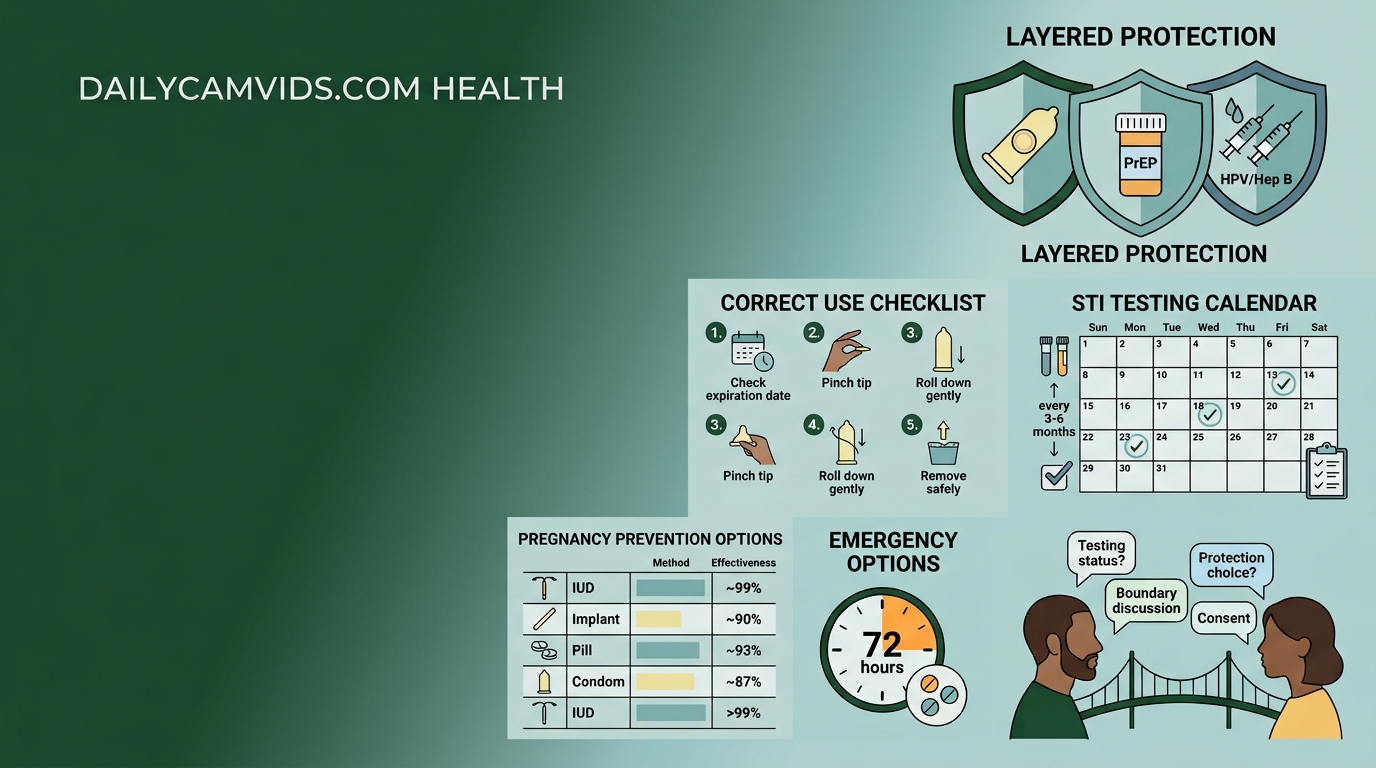
Condoms — both external (often called "male" condoms) and internal (often called "female" condoms) — are the only contraceptive method that provides significant STI protection. When used correctly and consistently, external condoms are highly effective.
External condom correct use:
- Check the expiration date before use
- Open the package carefully — avoid tearing with teeth or fingernails
- Place on the tip of an erect penis with the rolled rim on the outside
- Pinch the tip to leave space and roll down to the base
- Use water-based lubricant to reduce breakage risk; avoid oil-based lubricants with latex condoms as they degrade latex
- After sex, hold the base while withdrawing, then remove and dispose of (don't flush)
Correct use matters: "Perfect use" (correct and consistent) effectiveness for external condoms is around 98% for pregnancy prevention; "typical use" (accounting for real-world inconsistency) is around 87%. The gap largely comes from inconsistency and incorrect use, not condom failure.
Internal condoms: Can be inserted up to 8 hours before sex. Follow package instructions carefully. They're an option when a partner doesn't or won't use external condoms.
Other barriers: Dental dams (or internal condom unrolled) reduce STI transmission risk during oral sex on a vulva or anus. This is a lower-risk activity than unprotected penetrative sex, but risk isn't zero.
STI Prevention Beyond Condoms
Condoms are effective but not the only tool:
- PrEP (Pre-Exposure Prophylaxis): A daily medication (Truvada or Descovy in the US) that reduces HIV transmission risk by more than 99% when taken consistently. Requires a prescription; available through primary care, sexual health clinics, or specific PrEP providers. Often covered by insurance and available at low cost through patient assistance programs.
- Regular testing: Knowing your and your partner's STI status is itself a risk-reduction practice. Early detection and treatment of bacterial STIs prevents transmission to others and progression to complications.
- Vaccination: HPV vaccine protects against the strains responsible for most HPV-related cancers and most genital warts. Hepatitis B vaccine provides protection against hepatitis B. The CDC publishes current vaccination schedules and recommendations.
- Limiting simultaneous partners: Reduces overall exposure risk, though it's worth emphasizing that this is about probability, not character — one partner with an undetected STI carries the same transmission risk as one partner in a larger network.
Pregnancy Prevention Methods
Effectiveness rates for pregnancy prevention, by method (approximate typical-use annual failure rates from CDC and similar sources):
- IUD (hormonal or copper): Less than 1% — among the most effective available
- Implant: Less than 1%
- Sterilization: Less than 1%
- Combined oral contraceptive pill (typical use): ~7%
- Patch, ring, injection (typical use): ~7%
- External condom (typical use): ~13%
- Withdrawal (typical use): ~22%
- No method: ~85% per year
The gap between "perfect use" and "typical use" rates reflects real-world inconsistency — the hormonal pill has a perfect-use failure rate of less than 1%, but typical use is ~7% because of missed doses. Methods that require less daily action (IUDs, implants) eliminate this gap.
Combining Methods
Using more than one method simultaneously — often called "dual protection" — is the most effective approach for people who want protection against both STIs and pregnancy. The most common combination is a hormonal contraceptive (for pregnancy prevention) plus consistent condom use (for STI protection).
This approach acknowledges that no single method is optimal for both goals simultaneously. IUDs are highly effective at pregnancy prevention but provide no STI protection. Condoms address both but at a lower pregnancy-prevention effectiveness than hormonal methods.
When Barriers Weren't Used
If sex occurred without barriers when you wanted them:
- Emergency contraception: If pregnancy prevention is a concern, options include Plan B (levonorgestrel, most effective within 72 hours), Ella (most effective within 120 hours), or copper IUD insertion (within 5 days — most effective option overall). Available at pharmacies and sexual health clinics.
- PEP (Post-Exposure Prophylaxis): If there was a potential HIV exposure, PEP is an emergency medication course that must be started within 72 hours of exposure (sooner is better). Contact a healthcare provider or emergency room immediately if this applies.
- STI testing: After unprotected sex with a partner of unknown status, testing is appropriate. Some STIs have a window period before they're detectable — testing timing matters. A healthcare provider or sexual health clinic can advise on appropriate timing for different tests.
The Communication Aspect
Safer sex practices are more consistently applied when both partners have discussed them. "We always use condoms" or "I'm on the pill and we're both tested" requires a conversation — it doesn't happen by default. See our guide to talking to a partner about boundaries for practical approaches to these conversations.
React to this article
Comments
Loading…
Leave a comment
Loading…