What Are NSFW AI Tools? An Explainer
Contents
- Defining NSFW AI Tools
- Main Categories of NSFW AI Tools
- How These Tools Work
- Where These Tools Exist
- Content Policies and Restrictions
- Legal and Regulatory Context
- Key Considerations for Users
"NSFW AI" is a broad term that covers several distinct categories of AI tools that generate or facilitate adult content. This explainer breaks down what the term actually includes, how different types work, and the relevant legal and policy context.
Defining NSFW AI Tools
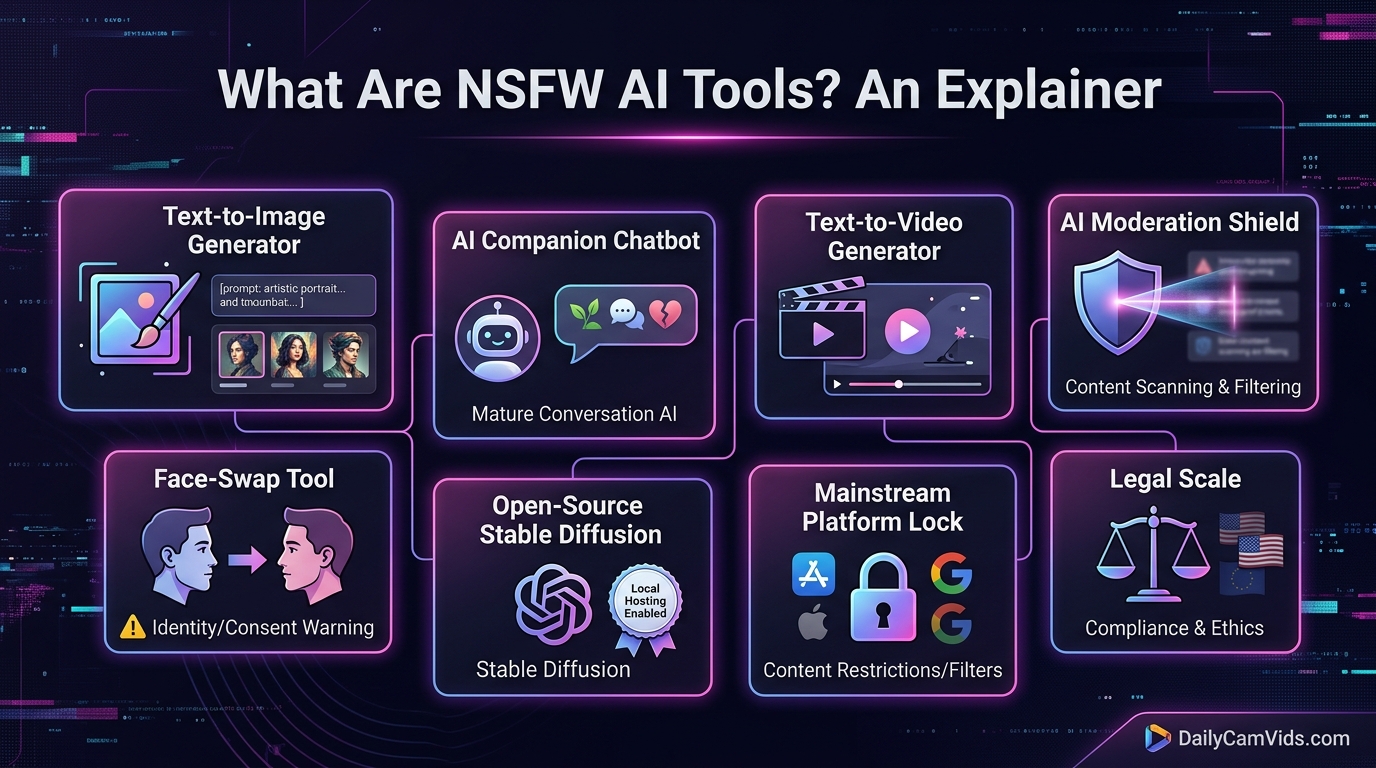
NSFW (Not Safe For Work) AI refers generally to artificial intelligence tools that generate, manipulate, or moderate adult or explicit content. This umbrella covers several quite different applications:
- AI image generators that produce adult imagery from text descriptions
- AI companion chatbots (covered separately in our AI girlfriend section) that engage in adult-oriented conversation
- AI video generation tools capable of producing adult video content
- AI content moderation systems that detect and filter NSFW content
- Tools that modify existing images, including face-swapping and content alteration
These are technically distinct tools with different capabilities, different policy landscapes, and different ethical considerations. Treating them as a single category leads to imprecise analysis.
Main Categories of NSFW AI Tools
Text-to-image generators: The most commonly discussed category. Tools like Stable Diffusion (open-source, can be run locally), and various platforms built on top of it, generate images from text prompts. Most mainstream commercial platforms (Midjourney, DALL-E, Adobe Firefly) do not allow adult content generation and have content filters in place. Specialized adult AI image generators exist and are generally built on open-source models fine-tuned for adult content.
AI companion/roleplay tools: Language models configured for adult conversation, with explicit content settings enabled. These range from general-purpose AI models with adult settings to purpose-built companion platforms. See our guides in the AI girlfriend section for detailed coverage of this category.
Text-to-video generators: A more nascent category than image generation, but advancing rapidly. Several tools can now generate short video clips from text descriptions. Explicit video generation faces both higher technical difficulty and more restricted access than still image generation.
AI content moderation: Used by platforms to automatically detect and flag NSFW content for human review, or to automatically remove it. This is one of the highest-value applications of AI in the adult content context — making it practical to moderate at the scale of large platform content volumes. See our article on AI content moderation on adult platforms for how this works.
Face-swapping and manipulation tools: Tools that can swap one person's face onto another's in images or video. This category has significant misuse potential (discussed in our deepfakes guide) and is subject to regulation in multiple jurisdictions.
How These Tools Work
The underlying technology varies by category:
- Image generators primarily use diffusion models (see our AI image generator explainer)
- Text-based companion tools use large language models (LLMs) — the same underlying technology as ChatGPT and similar tools, configured differently
- Face-swapping tools typically use GANs (Generative Adversarial Networks) or diffusion-based inpainting
- Content moderation uses classification models trained to distinguish adult from non-adult content
Where These Tools Exist
NSFW AI tools exist in several contexts:
- Dedicated platforms: Websites built specifically around adult AI image or companion services. Quality and policy compliance vary significantly.
- Self-hosted open-source tools: Stable Diffusion and similar models can be run locally on personal hardware. This removes platform-level content filters and places responsibility for use on the individual.
- Integrated features on adult platforms: Some established adult platforms (fan sites, cam platforms) are beginning to integrate AI image generation as a feature for creators.
- Underground/gray market tools: Tools that exist primarily to circumvent content filters on mainstream platforms or to produce content that violates mainstream platform policies.
Content Policies and Restrictions
Most mainstream AI companies — OpenAI, Google, Anthropic, Microsoft — prohibit adult content generation through their public products. This is a combination of business decision (mainstream platform positioning), legal consideration, and technical choice.
Open-source models like Stable Diffusion are available without these restrictions for users who run them locally, which is the main reason the open-source AI art community has developed significant adult content capabilities.
Dedicated NSFW AI platforms operate in a more permissive space but are not unregulated — they remain subject to laws in their jurisdictions governing what content can legally be produced and distributed.
Legal and Regulatory Context
The legal landscape for NSFW AI tools is evolving rapidly across jurisdictions:
- Several US states have passed laws specifically targeting AI-generated explicit content without consent (particularly addressing the deepfake-specific case)
- The EU's AI Act includes provisions relevant to certain AI content generation applications
- Most jurisdictions apply existing obscenity and child protection laws to AI-generated content as well as human-produced content — AI generation does not create a legal exception
Key Considerations for Users
For users considering NSFW AI tools:
- Platform legitimacy and terms of service matter — understanding what a platform does with generated content, data, and what it actually permits is basic due diligence
- Privacy implications vary — generating content through an online platform means content and prompts may be stored by that platform
- Legal constraints apply — existing obscenity law, consent-related digital image laws, and emerging AI-specific regulations vary by jurisdiction
- Content featuring real people without their consent raises ethical and legal concerns regardless of whether it's AI-generated
For the ethical dimensions in more depth, see the ethics of AI-generated adult content. For a practical look at what data these platforms collect and how to limit exposure, see our guide to privacy concerns with AI adult tools. The underlying systems are explained in the technology behind AI companions.
React to this article
Comments
Loading…
Leave a comment
Loading…