Why Live Cam Sites Are So Popular: The Psychology
Contents
- The Interactivity Advantage
- Parasocial Connection and Perceived Intimacy
- Real-Time Gratification
- Personalization and Agency
- The Community Dimension
- Scarcity and Live Presence
- What This Means for the Industry
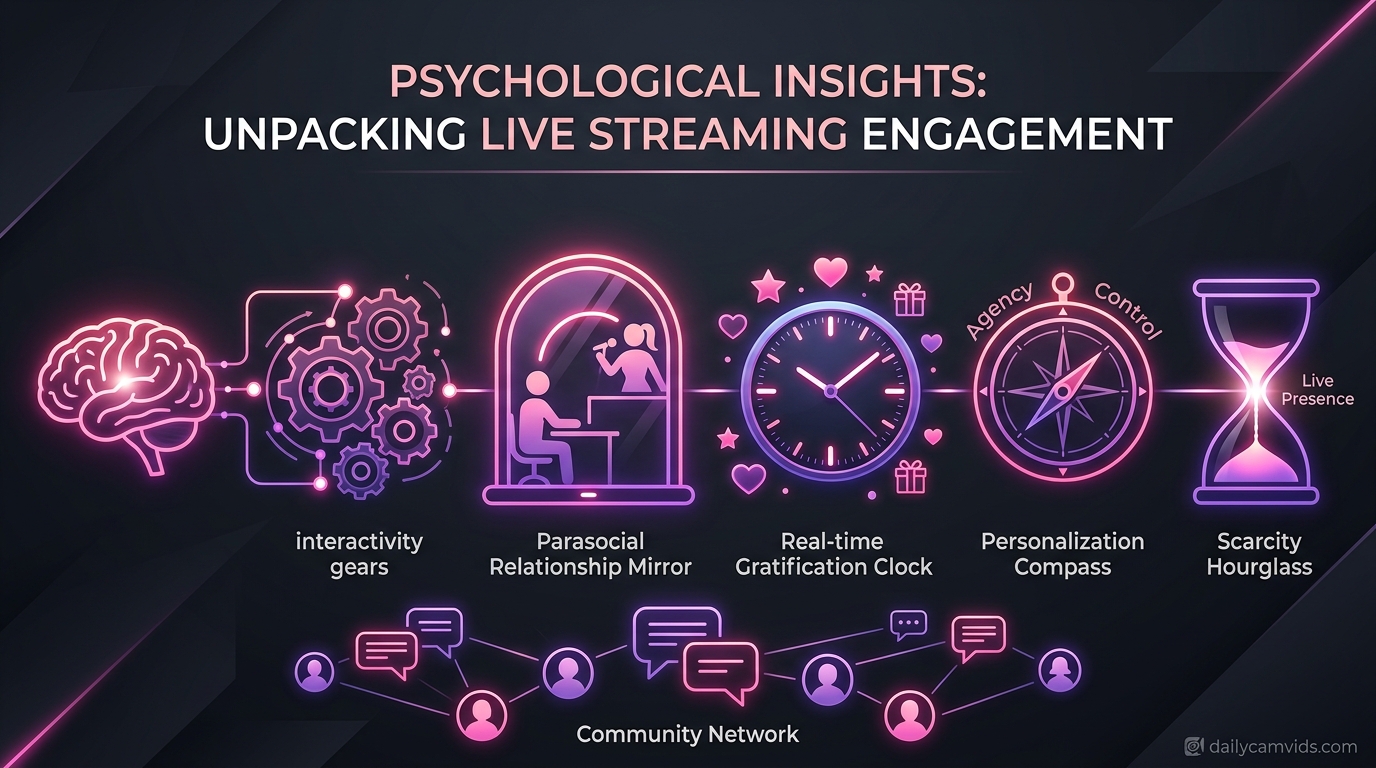
Live cam sites occupy a specific psychological niche that distinguishes them from recorded adult content. Understanding why live formats generate intense loyalty and spending behavior among viewers requires looking beyond the surface — the appeal is rooted in several well-documented psychological mechanisms that apply across live entertainment, not just the adult sector. This analysis draws on those broader principles to explain what makes live cam engagement distinctive.
The Interactivity Advantage
The fundamental difference between live cam viewing and recorded content consumption is interactivity. Viewers can directly influence what happens in a broadcast by tipping, making requests, or participating in chat. This transforms the viewer from passive consumer to active participant — a psychologically meaningful shift.
Research in behavioral psychology has consistently demonstrated that perceived control over an outcome increases engagement, enjoyment, and willingness to invest resources (including money) in an activity. The ability to tip and see an immediate response — whether that's the broadcaster acknowledging the tip directly or a progress bar filling toward a goal — creates a feedback loop with powerful reinforcing properties.
This interactivity dynamic is not unique to adult cam sites. It underlies the psychology of gaming, gambling, and the tipping behavior on mainstream live streaming platforms like Twitch. What live cam sites provide is a version of this interaction mechanic in a context that adds personal and relational dimensions.
Parasocial Connection and Perceived Intimacy
Parasocial relationships — one-sided social connections that viewers feel toward performers or public figures — are well-established in media psychology research. Viewers of popular YouTubers, podcast hosts, or sports athletes can feel genuine affection and a sense of connection without any reciprocal awareness from the person they're watching.
Live cam formats intensify parasocial dynamics through the real-time dimension. A performer who reads your username, responds to your message, or acknowledges your tip creates a moment of apparent mutual recognition — even if the interaction is brief and commercial in nature. The psychological impact of being "seen" in this way is disproportionate to the actual intimacy of the exchange.
Regular viewers of a specific cam performer often develop detailed knowledge of the person's life, preferences, and personality across many broadcast sessions. This accumulated familiarity deepens the parasocial bond. When a performer remembers a regular viewer's details — a skill many experienced broadcasters deliberately cultivate — the effect is substantially amplified.
Real-Time Gratification
Recorded content offers predictability; live content offers immediacy and unpredictability. The difference matters psychologically. Variable-ratio reinforcement schedules — where rewards come at unpredictable intervals — are among the most powerful known drivers of continued behavior in behavioral psychology. The live broadcast environment incorporates this naturally: viewers don't know exactly what will happen next, whether their request will be fulfilled, or what the broadcaster will do at any given moment.
This unpredictability is partly why live content generates longer average session times than recorded content. A viewer watching recorded content can fast-forward or click away without missing anything. A viewer of a live broadcast is anchored by the awareness that what they're watching is happening now and won't repeat.
Personalization and Agency
Viewers on cam platforms have a degree of agency over the experience that recorded content doesn't offer. They can request specific behaviors, set goals for what they want to see, choose which broadcaster to watch from among hundreds, and shape the session through tips and interaction. This sense of authorship over the experience increases investment — people value experiences they've had a hand in creating more than those passively received.
This is related to the "IKEA effect" in behavioral economics — the finding that people place higher value on products they've participated in creating. Applied to live cam viewing, the viewer who contributed tips toward a goal, had their request acknowledged, or otherwise shaped a broadcast session has a stronger sense of ownership over the experience than a viewer of equivalent recorded content.
The Community Dimension
Regular viewers of specific performers often form informal communities. Shared in-jokes emerge, regular chatters become recognized, and a sense of belonging develops around a broadcaster's channel. This community dimension adds a social layer to what might otherwise be considered purely individual entertainment consumption.
The social validation of being recognized as a generous or knowledgeable "regular" in a chat community provides status rewards that are distinct from the core content. Some viewers report that the community aspect of their favorite broadcaster's chat is as significant as the broadcast itself in explaining their engagement.
This dynamic is well-understood in live streaming more broadly. Twitch has documented that community belonging is a primary driver of platform loyalty among its core user base. The same mechanisms apply in the adult cam context.
Scarcity and Live Presence
The live format creates inherent scarcity: this broadcast is happening now, and won't happen exactly this way again. Scarcity is a well-established value driver in economics and psychology. Events, experiences, and content that are ephemeral carry a premium relative to infinitely reproducible goods.
Some platforms have experimented with archives and recordings of past broadcasts, but the revenue premium for live viewing versus recorded viewing has consistently favored the live format — suggesting that the scarcity and immediacy dimensions are not fully substitutable with after-the-fact access.
What This Means for the Industry
Understanding the psychological drivers of live cam engagement explains several structural features of the industry. The intense revenue premium for a small number of top performers (rather than equal distribution across all broadcasters) reflects the parasocial investment pattern — viewers concentrate loyalty and spending on a small number of performers with whom they have developed the strongest perceived connections.
It also explains why interactive technology (tips that trigger physical device responses, goal shows with collective contribution mechanics, viewer-named events) has been so effective at increasing tip volume — these features directly amplify the interactivity and perceived-agency mechanisms that drive engagement. For more on how these dynamics translate into earning patterns, see how cam models make money and how creators build a following.
React to this article
Comments
Loading…
Leave a comment
Loading…