How to Maintain a Healthy Relationship with Adult Content
Contents
- What a Healthy Relationship with Adult Content Looks Like
- Potential Effects of Heavy Consumption
- Self-Assessment Questions
- Managing Consumption Intentionally
- Adult Content and Relationships
- When to Seek Help
Adult content is widely consumed — surveys consistently show majorities of adults have viewed it. Like most things, consumption of adult content can exist on a spectrum from casual and unproblematic to patterns that cause real harm. This guide focuses on what that spectrum looks like, how to assess where you are on it, and how to maintain a relationship with adult content that doesn't negatively affect your wellbeing or relationships.
General educational information. For personal concerns, consult a mental health professional.
What a Healthy Relationship with Adult Content Looks Like
A healthy relationship with adult content is characterized by several features:
- Intentional consumption: You choose to view adult content when you want to, rather than using it compulsively or to avoid unpleasant feelings you'd rather not experience
- Absence of significant distress: Viewing adult content doesn't cause significant shame, anxiety, or distress that affects your functioning or wellbeing
- Doesn't displace other activities: Adult content consumption doesn't significantly displace sleep, work, social relationships, or other activities you value
- Doesn't negatively affect other relationships: Consumption doesn't create conflict in your relationships, secret-keeping that erodes intimacy, or comparison that affects how you experience real partners
- Separates media from reality: You understand that pornography is produced for entertainment and doesn't represent typical real-world sexual experiences, relationships, or body types
Potential Effects of Heavy Consumption
Research on the effects of pornography is an active area of debate in sexual medicine and psychology, with study quality varying significantly. Some patterns that appear consistently in research and clinical observation:
Unrealistic expectations: Pornography consistently depicts atypical sexual scenarios, body types, response patterns, and timelines. Heavy consumption without critical awareness can create expectations that create dissatisfaction with real-world sexual experiences or partners — not because those experiences are inadequate, but because the comparison point is unrealistic.
Escalation patterns: Some users report needing increasingly novel or extreme content to experience the same level of interest — an escalation pattern similar to habituation effects in other areas. Whether this represents a clinical concern depends heavily on what's being escalated toward and whether it causes distress or harm.
Compulsive use: For some people, adult content consumption takes on compulsive qualities — feeling unable to stop despite wanting to, viewing in inappropriate situations, or using it to manage emotional states rather than as entertainment. This pattern is worth addressing with professional support if it applies.
It's equally important to note: research does not support that all pornography consumption is harmful, or that moderate, intentional consumption causes the effects above. The distinction between casual consumption and problematic patterns is the relevant clinical and practical question.
Self-Assessment Questions
These questions are an informal self-check, not a clinical assessment:
- Do I feel like I'm in control of when and how much I view adult content, or does it feel compulsive?
- Does viewing adult content cause me significant shame, anxiety, or distress?
- Has adult content consumption affected my ability to enjoy sexual experiences with a partner?
- Do I find myself viewing in situations that are inappropriate (at work, when I'm meant to be doing something else)?
- Is adult content consumption taking time or energy away from things I value?
- Do I find real sexual experiences less satisfying compared to adult content?
If several of these questions prompt concern, speaking with a therapist who works in sex and relationship issues would be a useful next step.
Managing Consumption Intentionally
If you want to be more intentional about adult content consumption without necessarily eliminating it:
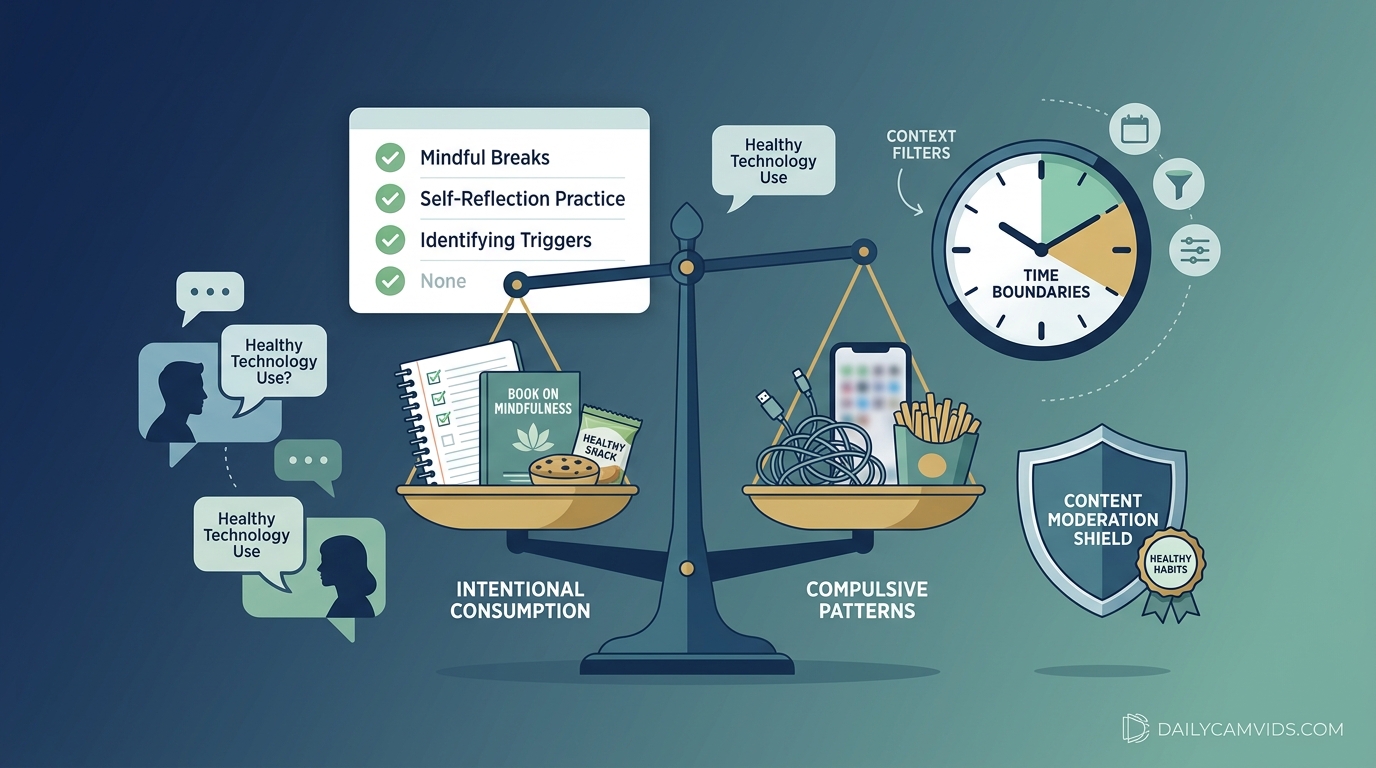
- Set time or context boundaries: Only viewing at specific times or in specific contexts (not on your phone in bed before sleep, for example) can reduce compulsive checking patterns
- Examine the emotional context: Noticing whether you're viewing for enjoyment versus as an avoidance or numbing strategy helps clarify whether consumption is serving you
- If you're trying to reduce or stop: Content filtering software, accountability apps, and structured reduction rather than cold-turkey approaches have the best evidence for sustained behavior change. Therapy (specifically cognitive-behavioral approaches) is effective for people who find solo efforts insufficient
Adult Content and Relationships
Adult content in relationships is a topic where values, communication, and individual variation all interact. There's no universal rule — couples have highly varied approaches, from no consumption to open discussion and shared viewing. What matters is whether both partners' perspectives and comfort levels are understood and respected.
If adult content is creating conflict in a relationship — secret-keeping, one partner feeling replaced or inadequate, or one partner's consumption affecting intimacy — these are relationship communication issues that benefit from direct conversation. Our guide to talking to a partner about boundaries and communication in relationships address the broader skills these conversations require.
When to Seek Help
Consider professional support if:
- Adult content consumption feels compulsive or out of control and you'd like to change that
- It's causing significant shame, distress, or anxiety that affects your functioning
- It's causing conflict in a relationship you value and you're struggling to resolve it together
- It's affecting your ability to experience or enjoy intimacy with partners
A therapist specializing in sex and relationships is the most appropriate resource. See when to see a professional about sexual health for guidance on finding appropriate support.
React to this article
Comments
Loading…
Leave a comment
Loading…