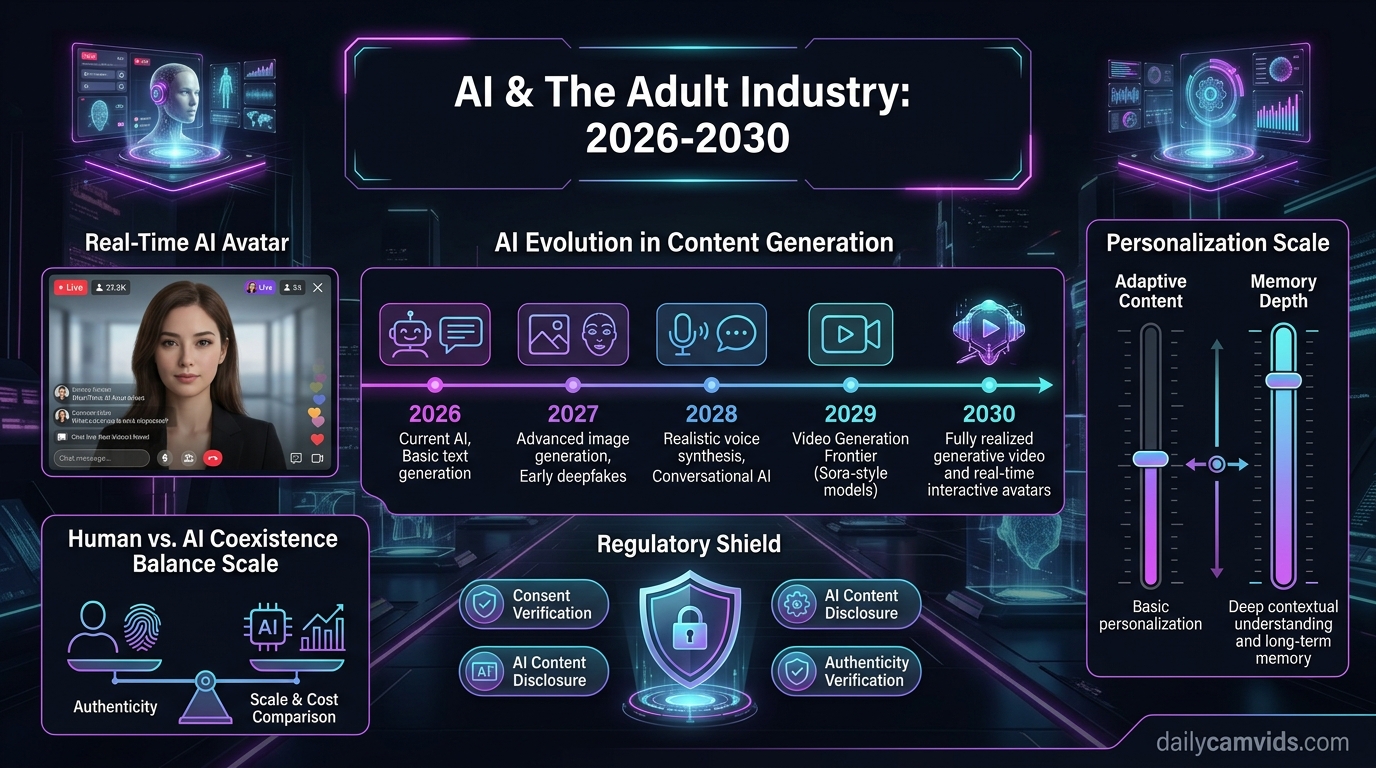
The Future of AI in Adult Entertainment
Contents
- Current State of AI in Adult Entertainment
- The Video Generation Frontier
- Real-Time AI Interaction
- Personalization at Scale
- Regulatory Trajectory
- Human and AI Content: Coexistence or Competition?
- What This Means in Practice
Predicting technology futures accurately is difficult, but identifying the directions where significant development effort is currently concentrated is more tractable. This analysis covers the near-term trajectory of AI in adult entertainment — the applications that are already in development or early deployment and that are likely to reach mainstream adoption within the next two to five years.
Current State of AI in Adult Entertainment
As of 2026, AI is integrated into adult entertainment in several established ways:
- AI image generation for synthetic adult content (well-established, widely available)
- AI companion platforms for conversation and relationship simulation (growing, covered in our AI girlfriend section)
- AI recommendation systems on major platforms (mature, running behind the scenes)
- AI content moderation for policy enforcement (widely deployed, see our AI moderation guide)
- AI translation and localization tools for creator content
The current state is characterized by image generation being mature and widely available, video generation being nascent but rapidly developing, and real-time AI interaction being early-stage. The next major wave involves the video and real-time dimensions.
The Video Generation Frontier
AI video generation — producing realistic video clips from text descriptions or extending/modifying existing video — is the most significant near-term frontier. The gap between current image generation quality and video generation quality is closing, driven by massive investment in video model development (Sora from OpenAI, Kling, Runway Gen-3, and others).
For the adult content industry, video generation reaching production-quality output would represent a more significant disruption than image generation did. Still images are already displacing some demand for photography-format content; video generation capable of producing realistic scenes would compete more directly with the core video product that most content platforms are built around.
Current limitations keeping video from this threshold: consistency of subjects across frames (a character should look the same throughout a clip), accurate physics and motion (bodies and objects moving naturally), duration limits (most current models produce clips of 5-10 seconds at quality), and output resolution. Each of these is improving iteratively with each model generation.
Real-Time AI Interaction
Real-time AI avatars — AI companions capable of conducting live video conversation rather than generating pre-made content — would directly compete with live cam platforms in a way that image generation doesn't. A live AI avatar that can see and hear the viewer through their camera and respond in real-time with appropriate verbal and visual responses represents a qualitatively different product from current text-based AI companions.
This technology exists in early forms — video calling with AI avatars is technically available today. The current limitations are in naturalness: realistic facial movement, emotional authenticity in real-time, and the latency between user input and avatar response. These are improving. A two-to-four year timeline for real-time AI avatars reaching a quality threshold that meaningfully competes with the live cam format seems plausible, though uncertain.
Personalization at Scale
AI enables personalization of content and companions at scales impossible with human content production. The trajectory here involves:
- Character customization: Already available on platforms like Candy AI, but becoming more sophisticated — companions that more accurately maintain specific personality definitions across long interaction histories
- Adaptive content: AI systems that modify content based on inferred viewer preferences in real-time — going beyond recommendation to actual content adaptation
- Memory depth: As LLM context windows expand and memory systems improve, AI companions will maintain more reliable and extensive relationship histories, approaching the "remembers everything" ideal
Regulatory Trajectory
Regulatory attention to AI in adult content is intensifying and will shape which applications develop versus which are constrained:
- Consent requirements: More jurisdictions are requiring consent from any real person depicted in AI-generated intimate imagery. This is becoming a baseline legal standard, not an outlier.
- Disclosure requirements: Requirements to disclose AI-generated content to viewers are emerging. The EU AI Act includes provisions in this direction; US federal legislative proposals are active.
- Age verification: Regulatory pressure for age verification of both viewers and depicted "performers" (even AI-generated) is increasing, particularly for explicit content. Platforms will need to invest in more robust verification infrastructure.
- Liability frameworks: How liability for harms (NCII, CSAM) applies to AI-generated content is being resolved through legislation and litigation. Clearer frameworks will shape which platforms can operate sustainably.
Human and AI Content: Coexistence or Competition?
The most frequently asked question about AI and adult entertainment is whether AI will replace human performers. The more nuanced answer:
AI-generated content and human-performed content serve overlapping but not identical needs. The research on why people watch live cam content (see our psychology of live cam sites article) points to authenticity, parasocial relationship, and genuine human interaction as significant drivers — needs that AI simulation addresses imperfectly by definition.
The likely near-term outcome is segment displacement rather than wholesale replacement: AI content captures market segments where authenticity and genuine interaction are lower priorities (certain content types, lower-cost access, specific fantasy fulfillment), while human performers retain competitive advantage in live interaction, authentic relationship, and the genuine parasocial connection that audiences highly value.
The mid-term outcome is genuinely uncertain — if real-time AI avatars reach a quality that produces indistinguishable-from-human interaction quality, the authenticity advantage narrows significantly.
What This Means in Practice
For viewers: More AI-powered options, higher personalization, and lower cost access points for AI content alongside continuing human-performed content. Better tools for verifying human vs. AI-generated content (provenance systems). More regulatory protection against non-consensual AI-generated imagery of real people.
For creators: Increasing competition from AI-generated content in lower-differentiated segments, with live interaction and authentic relationship remaining the strongest competitive advantage. AI tools available to enhance creator production workflows. A clearer regulatory landscape (in most jurisdictions) for what AI content is legal and permissible.
For the current state of AI companions, see our reviews in the AI girlfriend section. For broader industry trends, see adult content trends to watch in 2026.
React to this article
Comments
Loading…
Leave a comment
Loading…