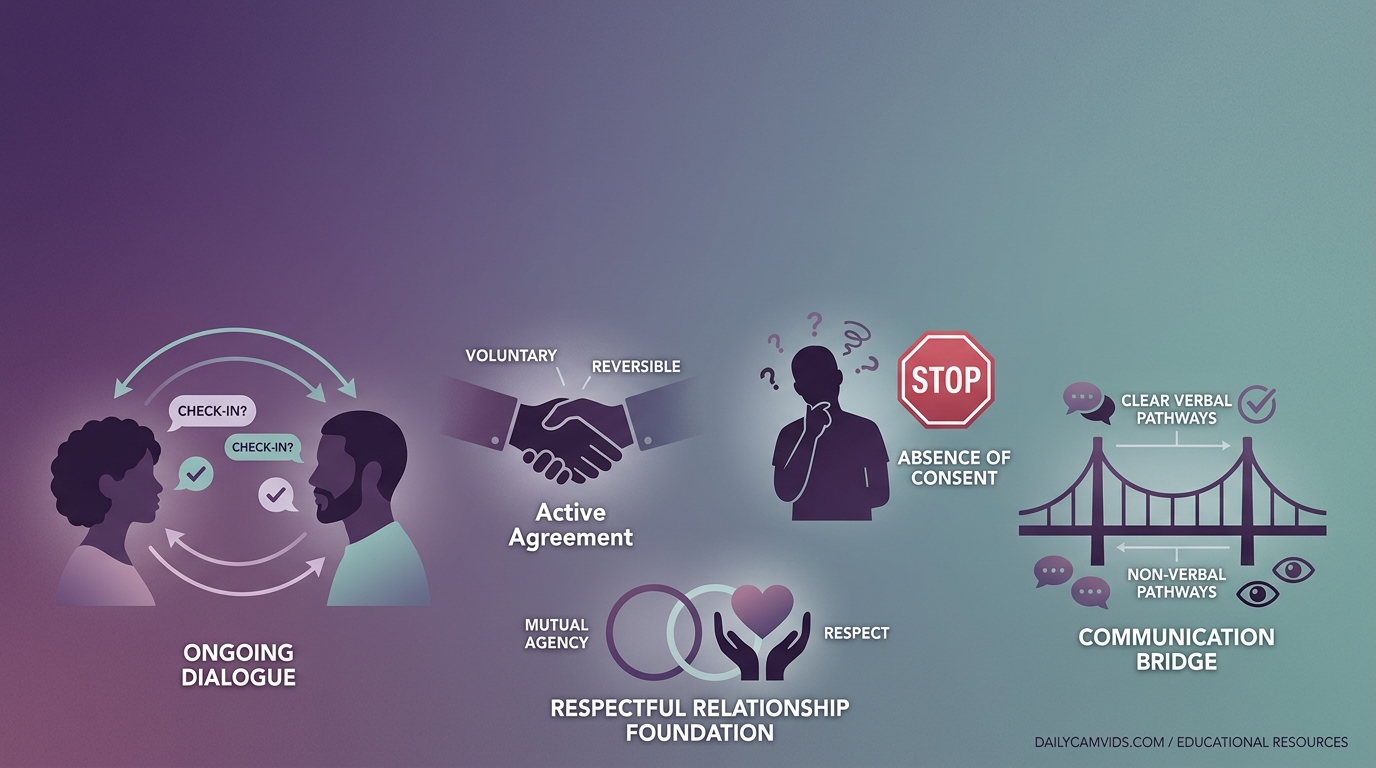
Understanding Consent: Why It Matters
Contents
- What Consent Actually Means
- Consent Is Ongoing
- Communicating Consent Clearly
- Recognizing the Absence of Consent
- Withdrawing Consent
- Consent in Different Contexts
- Why Consent Matters Beyond Law
Consent is one of the most discussed and one of the most misunderstood concepts in sexual health and relationships. This guide explains what consent actually means in practice — not as a legal compliance exercise but as a communication framework that forms the foundation of respectful relationships.
This guide is for general educational purposes.
What Consent Actually Means
Consent, in the context of sexual activity, is an active, voluntary, and ongoing agreement to participate. This definition has several components that matter in practice:
- Active: Consent is expressed — it's not assumed from silence, inaction, or past behavior. The absence of "no" is not consent.
- Voluntary: Consent given under pressure, coercion, or fear is not meaningful consent. The voluntary nature means the person is free to say no without negative consequences from their partner.
- Ongoing: Consent to one activity is not consent to all activities. Consent given at one time doesn't automatically extend forward in time.
- Reversible: Consent can be withdrawn at any time.
The legal definitions of consent vary by jurisdiction — the age of consent, the specific requirements for consent in law, and the standards applied in criminal or civil proceedings differ across states and countries. This guide addresses the relational and practical dimensions of consent rather than the legal specifics of any jurisdiction.
Consent Is Ongoing
One of the most important — and most commonly misunderstood — aspects of consent is its ongoing nature. Past consent to a specific activity doesn't imply future consent to the same or different activities. Being in a relationship, including a long-term one, doesn't imply consent to any particular sexual activity on any particular occasion.
In practice, ongoing consent means being attentive to a partner's engagement and comfort throughout an encounter, checking in when uncertain, and being responsive to signs of discomfort or hesitation — not just at the beginning.
Communicating Consent Clearly
Explicit verbal communication about consent is clearest and leaves the least room for misunderstanding. "Is this okay?" "Do you want to continue?" "Tell me if you want to stop" are simple examples of checking in.
Non-verbal communication — enthusiastic engagement, pulling someone closer, reciprocation — can also communicate consent, but non-verbal signals are more ambiguous and can be misread. When in doubt, asking is always appropriate and doesn't diminish intimacy. A partner who is genuinely enthusiastic about continuing will be able to confirm it.
Creating an environment where either partner feels comfortable expressing hesitation or saying stop requires that these expressions are met without defensiveness, pressure, or consequences. The communication works both ways — receiving consent communication is as important as giving it.
Recognizing the Absence of Consent
Understanding what consent looks like requires also understanding what its absence looks like. Signs that meaningful consent may not be present:
- Silence or lack of response, particularly when the person seemed engaged before
- Saying yes to specific things while nonverbally communicating discomfort
- Hesitation, uncertainty, or reluctance expressed verbally ("I don't know," "I guess")
- Apparent discomfort, tenseness, or lack of engagement
- Saying yes under visible pressure or after repeated asking (repeated asking is itself a form of pressure)
A "yes" obtained after pressure or in the context of visible discomfort is not meaningfully free consent. If there's uncertainty about a partner's engagement, the appropriate response is to stop and check in, not to proceed on the assumption that hesitation will resolve itself.
Withdrawing Consent
Consent can be withdrawn at any point — mid-encounter, at the start, after previously agreeing, regardless of how long the relationship has lasted or what previously occurred. "I want to stop" is always valid and should always be respected immediately and without argument.
The ability to withdraw consent without negative consequences from a partner is one indicator of a respectful relationship. Reactions to withdrawal — anger, pressure to continue, guilt-tripping — represent serious concerns about the relational dynamic, separate from any specific encounter.
Consent in Different Contexts
Intoxication: A person who is significantly intoxicated cannot give meaningful consent. The threshold for "significantly" varies in law and is often debated; from a relational standpoint, if a partner is visibly impaired, assuming consent is not appropriate.
Sleep: Someone who is asleep cannot consent. Sexual activity with a sleeping person who hasn't given explicit prior consent constitutes sexual assault in most jurisdictions.
Power imbalances: Consent can be complicated by significant power differences — between employers and employees, therapists and clients, teachers and students, or others in positions of authority. Many professional codes of ethics prohibit sexual relationships between people in specific power-imbalanced roles for this reason.
Why Consent Matters Beyond Law
The legal dimension of consent — what constitutes assault, what is prosecutable, what standards courts apply — is an important floor, but it's not the ceiling for what respectful relationships involve. Consent as a value, not just a legal requirement, is about treating partners as people with their own agency and preferences, not as passive participants in your experience.
Partners who communicate clearly about consent tend to have more satisfying sexual relationships — the research on sexual satisfaction consistently finds that communication and mutual attentiveness are strongly associated with relationship quality and sexual satisfaction. This makes consent not just ethically important but instrumentally valuable for relationship health. For more on the communication aspect, see our guide to talking to a partner about boundaries and communication in relationships.
React to this article
Comments
Loading…
Leave a comment
Loading…